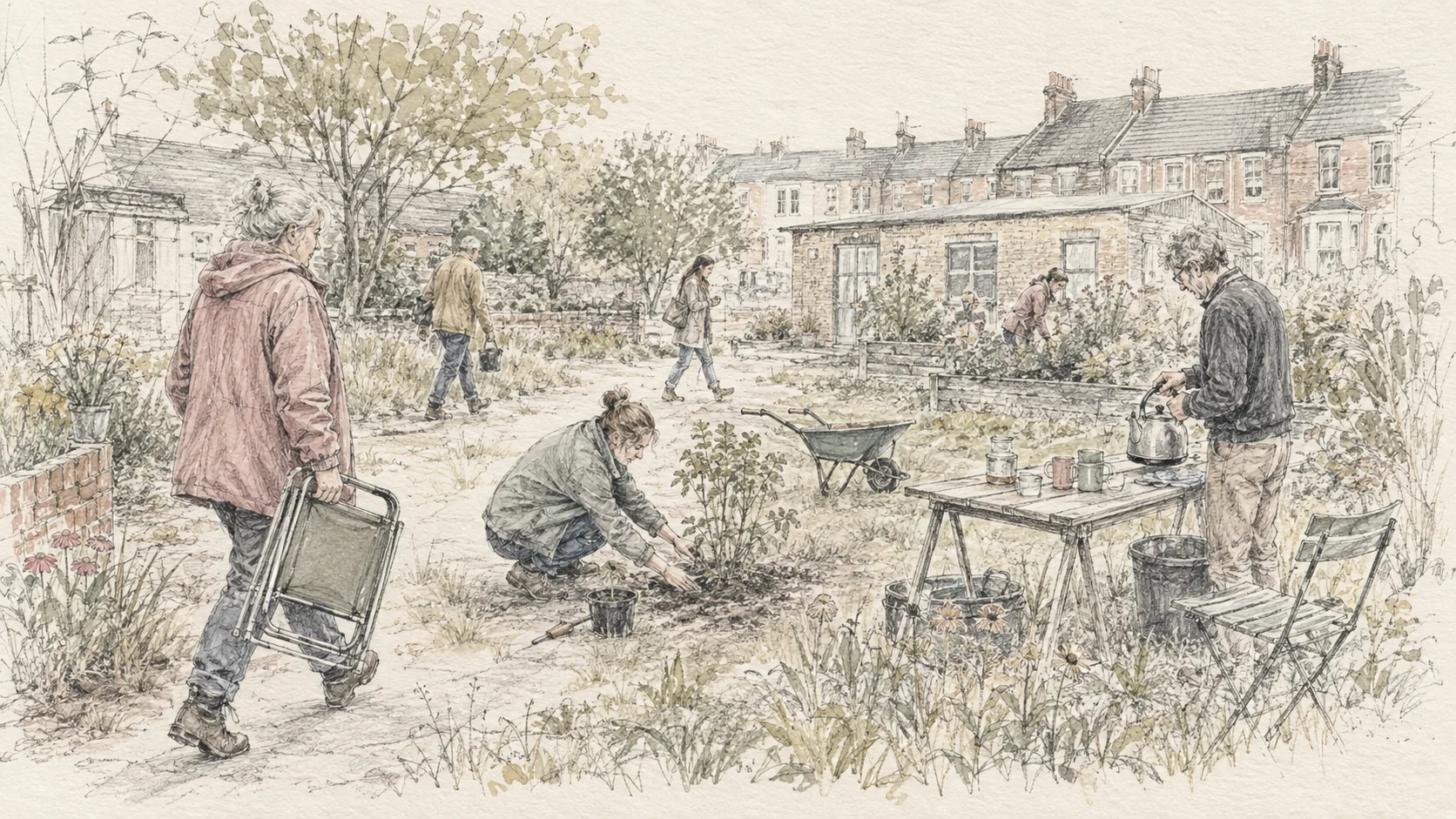
People rarely announce that they are lonely. They ask whether a chair is free, comment on the weather or return at roughly the same time.
Something to try: give people a reason to share a space without having to talk.
A shared place to begin
We are surrounded by ways to communicate, yet many people feel lonely, unseen and separated. This project offers small ways to reach out and asks what would make connection easier in daily life.
Our starting question
“What would make it easier for people to find company when they want it?”
Loneliness is not always solved by meeting more people. Time, trust, repeated contact, shared purpose and places where nobody has to perform all matter. That gives us somewhere concrete to begin.
Read the deeper explorationTry it this week
This is not a cure for loneliness and it should not become another self-improvement test. Choose one step or follow all seven. The aim is simply to make genuine contact a little easier.
When did you feel most connected this week? What helped: the place, the person or something you were doing together?
Write to someone without creating an obligation: ‘I thought of you today. No rush to reply.’
Spend half an hour somewhere people gather regularly: a library, park, café, class or place of worship.
If scrolling is taking time you’d like to spend elsewhere, try an evening without one feed. You could use the time for a call, a walk or a meal.
Replace ‘How are you?’ with something answerable: ‘What has taken most of your energy lately?’
Connection often grows around usefulness. Offer a lift, a cup of tea, an introduction or ten minutes of help.
Keep the one action that made contact feel easier. You can repeat it at a pace that suits you.
From the project notebook
These are starting ideas, rather than findings from a study. They may change as readers share their experiences.

People rarely announce that they are lonely. They ask whether a chair is free, comment on the weather or return at roughly the same time.
Something to try: give people a reason to share a space without having to talk.
“No rush to reply” changes the emotional weight of a message. An invitation can offer warmth without creating a task.
Something to try: make it clear that a reply can wait.
Belonging often begins before conversation. The same face, path or counter slowly turns a public place into somewhere known.
Something to try: return to a place you like and see whether it starts to feel familiar.
Already happening
Bridging Tomorrow did not invent this work. These established community models show how shared activity, free space and regular return can help relationships grow without forcing intimacy.
Community-led spaces where people connect through practical interests, shared skills and useful projects. The activity gives conversation somewhere natural to begin.
Visit UK Men’s Sheds AssociationAccessible local gatherings bring neighbours and volunteer repairers together around broken objects, sharing skills and getting to know one another.
Visit Repair Café InternationalPublic libraries offer free places to read, use resources or spend time near other people. Facilities and access vary, so check your local library before visiting.
Visit Libraries ConnectedA small thing to use
Print a sheet of cards for offering tea, a walk, a trip to the shops or ten minutes of help. Each one is built around the same principle: kindness without pressure.
Print the invitationsI’m making tea anyway.
You would be welcome to join me.No need to explain, and no pressure to reply.A Bridging Tomorrow invitationHelp shape the next version
Tell us about a place, routine or small gesture that helps people become familiar to one another. A polished answer is unnecessary; one observation is enough.
Share what you have noticed